The Five Kingfishers of the Pantanal, Brazil
A companion piece to our 2018 trip to the Northern Pantanal, updated with photos from our return to the Southern Pantanal in 2026. For the full story, see Jaguars Galore and our Wildlife in the Pantanal gallery.
The main reason for our trip to the Pantanal was to see Jaguars, but we had been told that the birds were stunning too. With over 600 species and very few people to disturb them, it is a paradise for birders and photographers, and it’s often possible to get fairly close to many of them. That was particularly true of the kingfishers along the rivers and ponds. Before we travelled, we asked a keen birder who had just returned from a similar trip whether we would see kingfishers. She assured us we would – but we never expected to see and photograph so many. Identification wasn’t always easy, though, as three of the species look very similar.
The five kingfishers of the Pantanal
- Ringed Kingfisher – about 40cm
- Amazon Kingfisher – about 30cm
- Green-and-rufous Kingfisher – about 24cm
- Green Kingfisher – about 19cm
- American Pygmy Kingfisher – about 13cm
As they all feed mainly on fish, most of our sightings came as we cruised the river systems by boat or drove past the many swampy ditches along the track. Here they are, from the largest to the smallest.
Ringed Kingfisher
The largest and most common of the five is the Ringed Kingfisher.

At almost 40cm long, it was the most distinctive species we came across. It is blue-grey with a red-brown chest, and is easy to see along the riverbanks. It is found throughout South and Central America, as far south as Tierra del Fuego, and has spread north into the lower Rio Grande valley in Texas.
Amazon Kingfisher
The second largest is the Amazon Kingfisher, at about 30cm long.

Its upperparts are an oily green, with a distinctive ragged crest and a white collar. Like the Ringed Kingfisher, it is found around lakes and slow-flowing rivers, from Mexico to central Argentina.
Green-and-rufous Kingfisher
The Green-and-rufous Kingfisher is arguably the most attractive of the five, and one of the less common.


At 24cm long it isn’t the smallest, but it is very hard to spot. Its dark glossy green upperparts, white-spotted wings and rufous nape all make excellent camouflage.
Like the others, it lives around streams and rivers. It is found from Nicaragua, through Central America and across much of northern South America, as far south as Paraguay.
Green Kingfisher
Next in size comes the Green Kingfisher.


At about 19cm long, it looks like a smaller version of the Amazon Kingfisher, with dark green upperparts, a white collar and a rufous breast band – although females lack the rufous colouring.
Like the others it is always found near water, but being smaller it seems to favour narrow streams and the edges of ponds, where dense, low vegetation provides perches close to the water.
American Pygmy Kingfisher
The fifth and smallest of the Pantanal’s kingfishers is the American Pygmy Kingfisher.

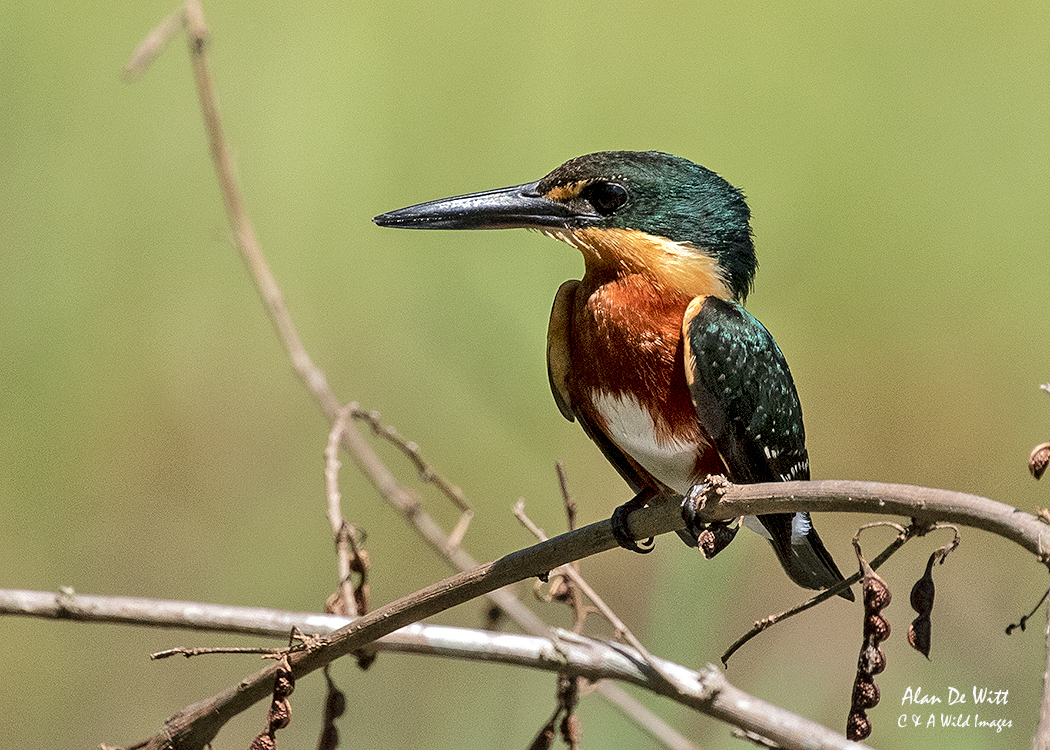
At only about 13cm long, it was the species we saw least often, even though it is widespread in the Pantanal – probably because of its tiny size and colouring. It is dark green above, with a buffy-orange collar, rufous underparts and a small white belly. It often perches on low, overhanging branches, staying well hidden in the dense undergrowth along the banks.
It ranges from southern Mexico, through Central America, to central Brazil.
Back in the Pantanal in 2026
In July 2026 we returned to the Pantanal, this time to a very different part of this vast wetland – the remote Southern Pantanal. We spent four nights at Baía das Pedras Ranch, then four more at Fazenda Barranco Alto on the Rio Negro. Once again the kingfishers were a highlight. On the river, Ringed and Amazon Kingfishers were a constant presence, fishing from the overhanging branches, and we were delighted to have the chance to photograph them again. You can read about the trip in Jaguars and Giant Anteaters on the Rio Negro.


Telling them apart
Size is the best clue, but it can be hard to judge on a lone bird. The Ringed Kingfisher is easy, with its blue-grey back. The other four are all green above. The Amazon and Green Kingfishers look much alike, but the Amazon is far bigger, and the Green has white spots on its wings. The Green-and-rufous and American Pygmy are the two with rufous underparts – look for the Pygmy’s tiny size and small white belly.
More from the Pantanal
- Jaguars Galore – eight Jaguars on the Cuiabá River
- Wildlife in the Pantanal – our 2018 photo gallery
- Southern Pantanal: Beyond the Jaguar – our return in 2026
- Jaguars and Giant Anteaters on the Rio Negro – where Ringed and Amazon Kingfishers were a constant presence