Humpbacks in Juneau
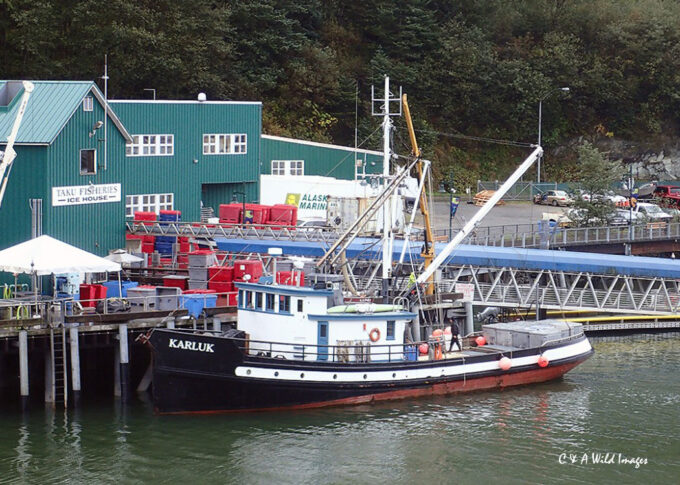
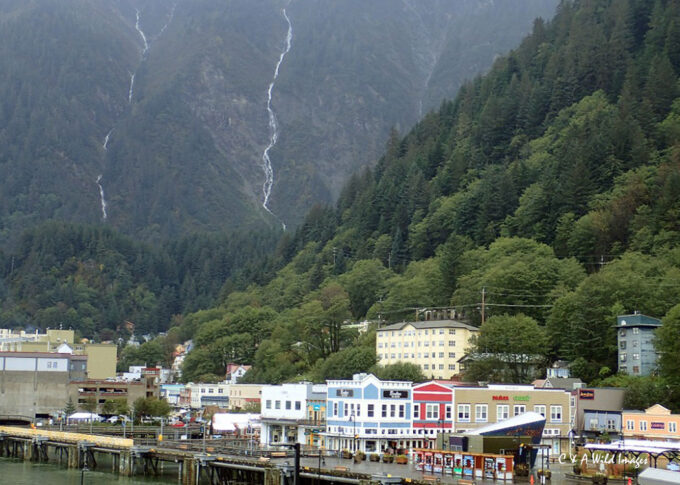
Departing British Columbia in brilliant sunshine, we ventured up the narrow Johnson Strait, eventually making Juneau our first port of call in Alaska. Unfortunately, the weather had closed in with light rain and mist enveloping the mountains. Locals kindly informed us that this was considered a good day in these parts. After a smooth disembarkation, we had the freedom to explore Alaska’s state capital. With a whale-watching excursion scheduled for the afternoon, we took the opportunity to learn more about the town. Interestingly, despite having a 50-mile road, access is limited to air or sea.
Fun fact: Juneau, once a gold mining town named after Joe Juneau, one of the original prospectors who discovered gold with Richard Harris in 1880. The town is nestled beneath the peaks of Mount Roberts and Mount Juneau, surrounded by a vast ice field feeding numerous glaciers. The most accessible of these is the Mendenhall Glacier. Our exploration revealed that the town mainly consists of jewelry and T-shirt shops, which didn’t quite align with our interests. After a brief stint, we decided to head back to the port to meet up with our excursion guide. Excitement for the whale-watching adventure loomed on the horizon.
Boarding the Research Vessel
Opting for the “Discover Alaska’s Whales” excursion with the Gastineau Guiding Company. Aboard a specially designed research vessel, our journey wasn’t just about spotting whales; it delved into the marine ecosystem by sampling the water’s food chain. Our guide, Caitlin, a marine scientist, greeted us, and we embarked on an approximately 8-mile drive to Auke Bay. Along the way, she shared insights into local landmarks, the history of gold mining, and the intriguing backstory of Juneau. She also introduced us to the Citizen Science program, an engaging element of our upcoming activities, involving the observation of humpback whale behavior, phytoplankton sampling, and the examination of several crab pots.
Once on board the research vessel, a thorough safety briefing prepared us for the upcoming experiences. The weather showed signs of improvement as we left the bay, treating us to breathtaking views of the mountain peaks and the Mendenhall Glacier from the sea.
Checking the Crab Pots
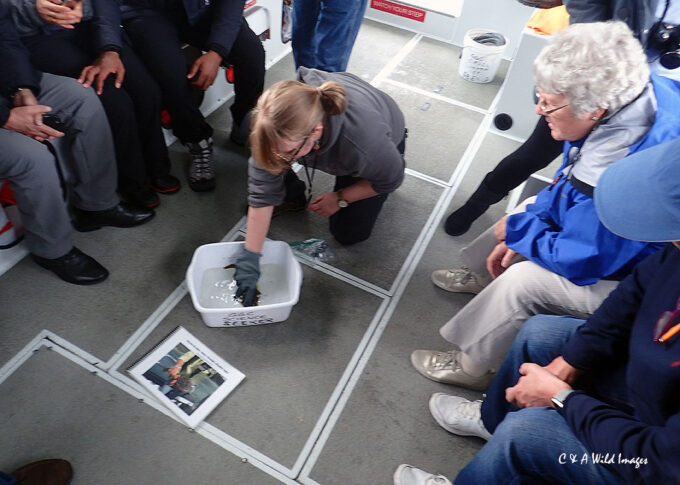
Our first stop was to haul in a crab pot to check whether it held any European Green Crabs, an invasive species. Like many invasive species without any control they have the potential to out-compete the native Dungeness crab. No crabs in the pot this time but a strange looking fish, Caitlin put on gloves because the fish had poisonous spines and teeth, much like a larger version of a weaver fish often found around the UK coasts. After examining the fish, we returned it unharmed and completed the paperwork
Next we took a sample of the sea water to look for the density of the plankton, (krill for the humpback whale). The sample pot was full and you could clearly see the abundance of plankton that provides a crucial source of food to many large aquatic organisms that inhabit the waters of the Stephen’s passage.
Hunting for the Humpbacks
Now it was time to find the whales. Almost immediately a plume of water was visible from the whales’ blow spurting high in the air. Incredibly excited we watched as coming towards us we could see a small dark dorsal fin and the humped back. It disappeared below the surface with no fluking up this time, however, Caitlin thought it was travelling and would reappear in about 10 minutes.
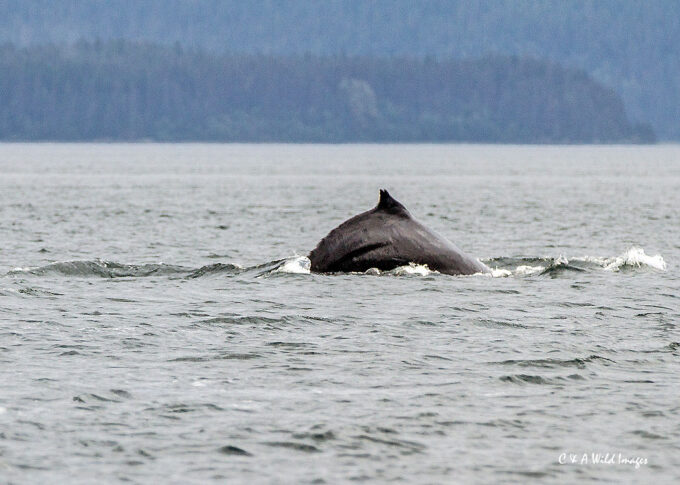
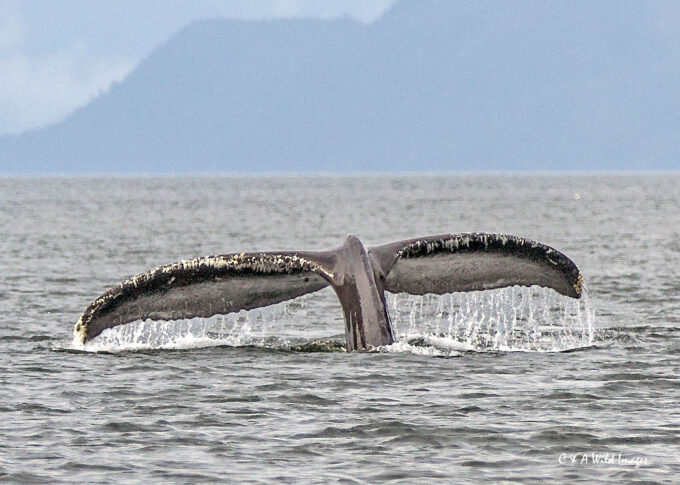
Sure enough another large spout of water shot high into the air followed by the characteristic small dorsal fin. Followed by the dark shape of the hump. This time with a noisy slap of the water. More flukes appeared above the surface as another whale dived in search of food. Sometimes only the fin and the humped back was visible at other times the tail flukes lifted out of the water as the whale dived.
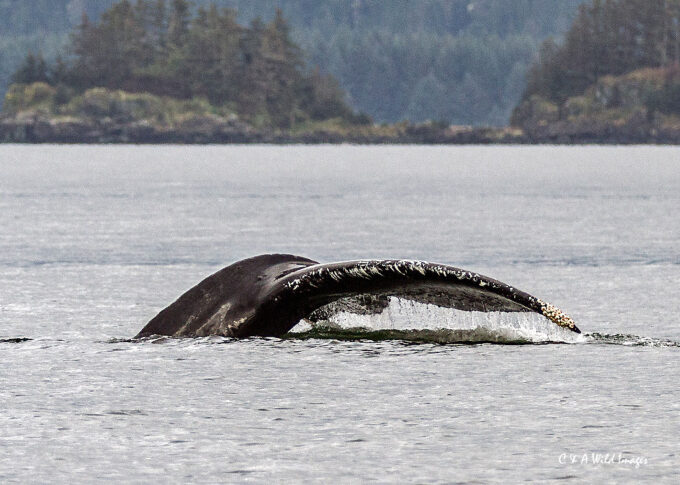
Seven Individual whales
We counter about seven individual whales in a relatively small area of Stephen’s passage. Mainly they seemed to be either travelling along or diving for food. At this time of the year many of Humpbacks that inhabit these waters. Have headed off to their winter breeding grounds in Hawaii so seeing this number was thought to be unusual. An amazing experience.
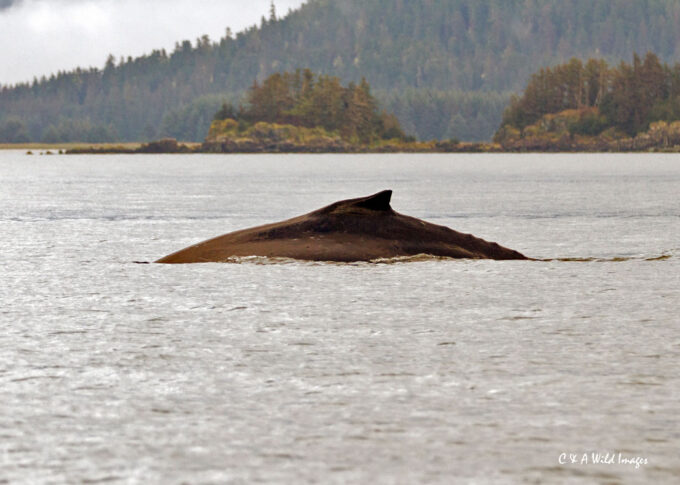
After some discussion of the tail patterns, which we had seen and how they help identify each individual. Its seems that the underside of the fluke have a pattern of black and white markings that are used. The then we got to look at a piece of baleen, made from keratin same as our fingernails. Humpbacks are baleen whales feeding on krill and small fish like herring. Once again details of our observations of the whales’ behaviour had to be completed.
Steller Sea Lions
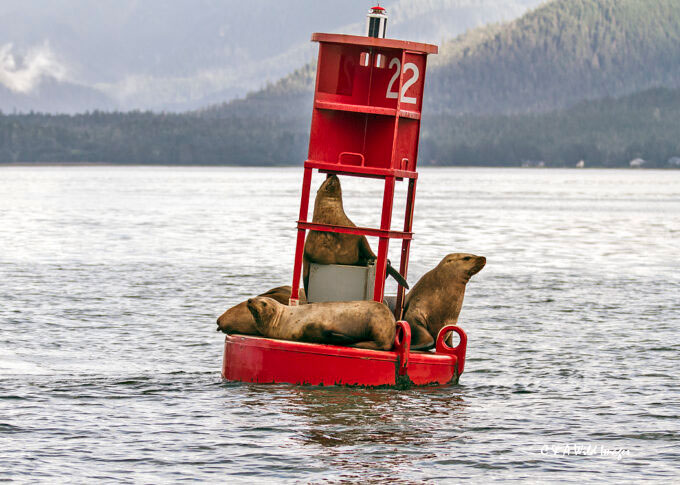
On the way back to the marina we stopped by a buoy. Which was being used as a resting place by Steller sea lions, the largest of the true “eared” seals. They were probably a bachelor group, who were vying noisily for position on the buoy. Using their long front flippers and rotatable hind limbs to climb over each other.
Back to Juneau
Back at the marina as we moored the boat four bald eagles were squabbling on the foreshore. Two flapping and squawking in the trees. The others on the narrow strip of shore over some food they had found, probably dead salmon.
The drive back into Juneau was interesting, with discussion on the difference between a salmon hatchery and farm and the presence of black bears on Juneau streets .The tide had gone out and the mud flats were visible between the mainland and Douglas Island, making it possible to just walk between them, a channel that not so long ago was used by ships as a route to the Stephen’s Passage, Despite the poor light and weather conditions it was a very enjoyable afternoon and an excursion I would recommend.
Thank you for the wonderful photos of the afternoon we spent whale watching in Auke bay. I really appreciate you letting me take copies of your photos as my camera was so inadequate my images of the whales were small black blobs in the distance. Thoroughly enjoyed a wonderful holiday in Canada and Alaska. Oh and the commentary is excellent as well. What a fantastic website!
Congratulations on a most absorbing piece of work which took me with you on your voyage of discovery. I almost felt the temperature of the environment on your wale watching
expedition. Fascinating and informative.