Beaver Diaries October 2024
The first days of October saw heavy rain return, transforming the reserve back to its wetter state from earlier in the year. For both the beaver survey team and ourselves, navigating the site became a significant challenge once again. On our first visit, it quickly became clear that reaching the trap to replenish the apples would not be easy. What we didn’t realize was just how much rain had fallen. This sudden shift in conditions added a new layer of complexity to the month’s beaver monitoring efforts.

First Visit – 4th October
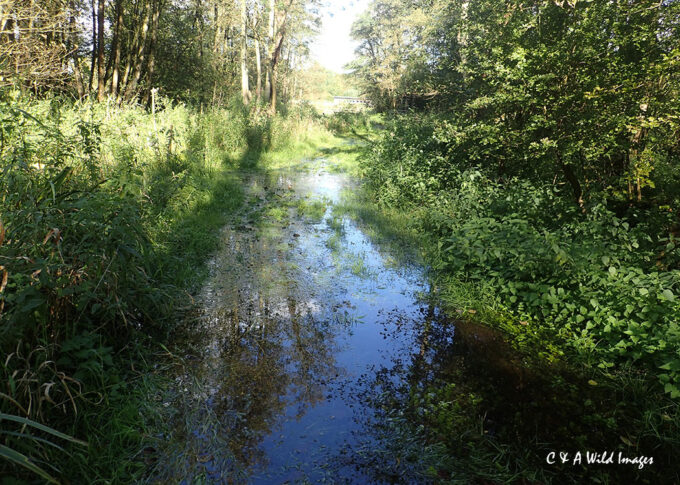
Our first visit of October started at Gate One, heading to the sluice, which was blocked again. Water levels were high on both sides of the sluice, leading to flooding across the meadows and into the woods. By the time we got through Gate Three, Oak Fen was completely underwater, making it clear how much rain had fallen in the past few days.

Checking the cameras in Plantation Wood proved to be a challenge. The water levels were so high that it took three attempts—and a borrowed pair of waders from the cabin—to reach one camera. Thankfully, we’d mounted it higher up on a tree trunk, sparing it from the rising water. The high water made navigation around the site similar to winter conditions, with paths and tracks almost impassable
Reaching the Bavian beaver trap meant a detour through the Wetland Hide, much like in winter. Despite some challenges, we collected all the SD cards. The footage showed the beavers actively feeding on the platform, enjoying apples, and moving in and out of the trap. With rising water levels, they were busy building dams. We also captured great daylight views of the beavers.
Around the Enclosure
Elsewhere, Poplar Wood was flooded again, Dam Six was nearly underwater, and the channel crossing the track at the dragonfly gate was once again completely submerged. The amount of water on the reserve after just a couple of days of rain was striking.
The beavers had chewed through the rope securing the feeding platform and started gnawing on the surrounding wood. We moved the platform to a narrower part of the drain. A camera was set up nearby, and apples were added to attract the beavers.
Finally, we collected a red battery pack from one of the cameras and took it back to the cabin for recharging. The flooding made this visit particularly challenging, but the beavers remain as busy and adaptable as ever.
Second visit – Mid-October
On our second visit of the month, water levels had receded slightly compared to earlier in October,, but Dragonfly Meadows and Plantation Wood remained flooded. Access to the beaver trap from Gates One and Two remained difficult, so we used the Wetland Hide route again.
The water level in Oak Fen Drain has stayed consistently high this year, and much of Poplar Wood was still underwater. Dam Six had been breached again, with water spilling over into nearby areas.

During the visit, we saw swans, greylag geese, mallards, a heron, and a number of cormorants on the wetlands. Dragonflies were still active, and the warmer weather brought out a few butterflies. Alder trees were beginning to change color, with some already losing their leaves.
Access to Dragonfly Meadow from Oak Fen Drain was blocked by high water. This time, we only left apples at the feeding platform. We collected SD cards from all the trail cameras. Two cameras were moved closer to the drain since the flooded conditions made the wooded areas difficult to reach.
Back home, the trail camera footage provided good views of the beavers, especially around the feeding platform. The recordings showed this year’s new kit looking healthy and more independent, a positive sign of its development.
The beavers remain active despite the challenging conditions, with plenty of interesting behavior captured on the trail cameras although since our last visit little evidence of any other species captured on camera

Third Visit – 22nd October
On our third visit this month, we were immediately met with extensive flooding in the Dragonfly Meadow and the IDB drain, where water levels were exceptionally high. Moving around the reserve proved challenging, and once again, we had to use the route via the Wetland Hide, taking care not to disturb birdwatchers.
The weather was still warm enough for butterflies to be flying, which felt unusual for late October. Heavy rain and warm temperatures have defined this autumn, and while vegetation along the drains is dying back, there’s still little sign of widespread leaf fall. Strong winds since our last visit had brought down branches, including one from a tall dead tree that fell onto a camera. Fortunately, the camera wasn’t damaged, but it was knocked out of position, leaving us without footage from that spot.
The track from Oak Fen Drain to Dragonfly Meadow Gate was flooded, making it nearly impossible to reach the trap or access Plantation and Poplar Woods. We kept the visit short, focusing on retrieving SD cards from cameras that were easier to access along the drain.
Reviewing the footage back home revealed how rapidly water levels can change. Near the sluice and in Plantation Wood, the dry woodland floor visible one day had transformed into flooded terrain by the next, deep enough for beavers to swim. The footage clearly illustrated the adaptability of the beavers as they navigated and thrived in these shifting conditions.
| Otters | Hedgehog | Pheasant |
| Muntjac | Rat | Squirrel |
| Water Vole | Weasel | Wood Mouse |
| Wren | Robin | Heron |